Quay County Dog Registration Information
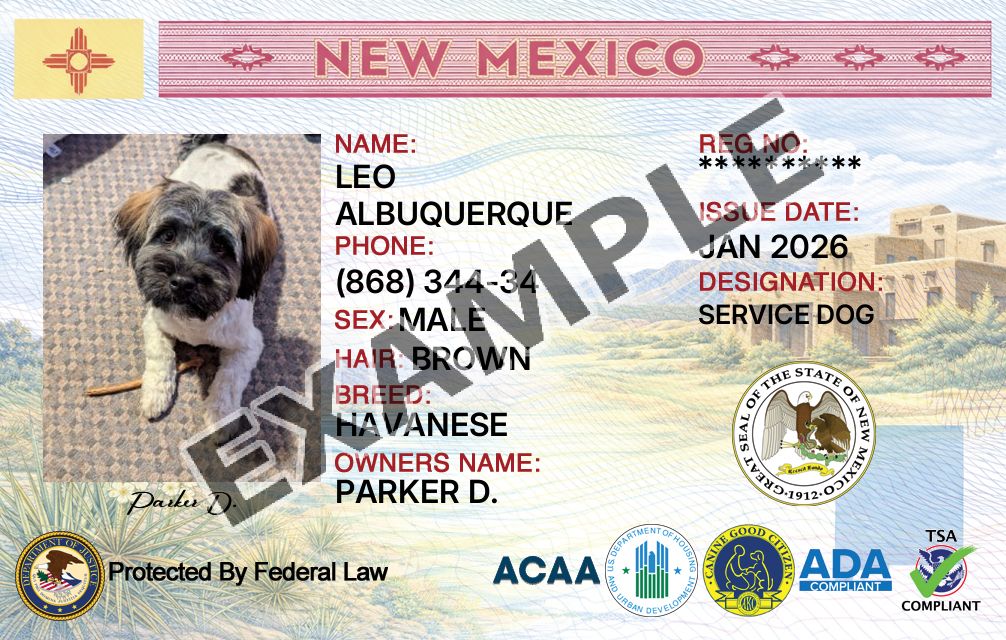
Service Dogs and Emotional Support Animals in Quay, New Mexico
Where Do I Register My Dog in Quay County, New Mexico for a Service Dog or Emotional Support Dog?
If you’re searching for where do I register my dog in Quay County, New Mexico for my service dog or emotional support dog, the most important thing to know is that dog “registration” usually means a local dog license (if required) and rabies compliance—not a special state or federal “service dog registration.” In Quay County, requirements are commonly handled by the city or village where you live (for example, the City of Tucumcari, Village of Logan, or Village of San Jon), and enforcement often runs through animal control, law enforcement, and local ordinances. This page explains how a dog license in Quay County, New Mexico typically works, which official offices to contact, and how dog licensing differs from service dog legal status and emotional support animal rules.
- A dog license (if required) is a local pet compliance process often tied to rabies vaccination and local ordinances.
- A service dog is generally recognized based on training and disability-related work/tasks—not a paid online registration.
- An emotional support animal (ESA) is generally supported by housing-related documentation (when applicable) and does not grant the same public access rights as a service dog.
Where to Register or License Your Dog in Quay County, New Mexico
Because licensing and animal control are often handled locally, start with the official office that serves your city/village limits. If you live outside any municipal boundary, you may still need to follow state rabies requirements and contact county-level offices for enforcement guidance. Below are several official offices in Quay County that may be involved in animal control dog license Quay County, New Mexico questions, rabies enforcement, and local ordinance compliance. (Contact details are listed only when available from official or established public listings.)
Tucumcari Animal Control & Shelter (Tucumcari Police Department)
City of Tucumcari — City Hall
Village of San Jon — Village Hall / Animal Control Contact
Village of Logan — Village Offices
Quay County Sheriff’s Department
Quay County Clerk (County Contact / Routing)
Overview of Dog Licensing in Quay County, New Mexico
What “dog registration” usually means
When people ask where to register a dog in Quay County, New Mexico, they are usually referring to one (or more) of these local compliance items: (1) a local dog license or tag if your city/village requires it by ordinance, (2) proof of a current rabies vaccination (and sometimes the rabies tag number), and (3) contact information on file so that animal control can return a lost dog and enforce public health requirements.
Local control is common in New Mexico
In New Mexico, counties and municipalities may adopt ordinances to require dog licensing for dogs over a certain age, set fees, and require proof of rabies vaccination before a license is issued. That means the process for getting a dog license in Quay County, New Mexico often depends on whether you live inside the City of Tucumcari, the Village of Logan, the Village of San Jon, or another local jurisdiction.
Rabies vaccination is a core requirement
Regardless of whether your area requires a formal dog license, rabies control is treated as a public health issue. In New Mexico, dogs over a minimum age are required to be vaccinated against rabies, and owners may be required to show proof of vaccination to animal control when asked. Keeping rabies paperwork current is one of the most important steps for compliance, licensing, travel, and resolving bite/incident investigations.
How Dog Licensing Works Locally in Quay County, New Mexico
Step 1: Confirm your jurisdiction (city/village vs. outside city limits)
Start by identifying where you live:
- Inside Tucumcari city limits: contact Tucumcari Animal Control & Shelter (through the Tucumcari Police Department) and/or City Hall for ordinance-based requirements.
- Inside the Village of Logan: start with the Village Offices (and, if needed, public safety/police contacts) for local ordinance guidance.
- Inside the Village of San Jon: start with the Village Hall / Animal Control contact listed above.
- Outside municipal limits (rural Quay County): licensing may be different or not offered as a countywide “license,” but rabies rules and nuisance/stray enforcement still apply. When in doubt, call the Quay County Sheriff’s Department and ask who handles animal control functions for your location.
Step 2: Keep rabies vaccination current and keep your documentation handy
Most local licensing systems (where they exist) use rabies vaccination as the minimum eligibility requirement. Keep a copy of your dog’s rabies certificate and the rabies tag information from your veterinarian. If animal control requests proof, having it available helps prevent delays and confusion.
Step 3: Ask whether a dog license/tag is required where you live
Local ordinances can differ. Some communities issue a yearly dog tag, while others focus primarily on vaccination, leash, at-large rules, and nuisance enforcement. When you call, use clear language like: “I live at [address]. Do you require a dog license or registration tag, and what documents and fees do I need?”
Step 4: Understand what a license does (and does not) do
A local license is mainly an identification and compliance tool. It can help reunite you with a lost dog and can support public health enforcement. It does not automatically grant public access rights or “certify” a dog as a service animal or ESA. Those are separate legal concepts explained below.
Service Dog Laws in Quay County, New Mexico
Service dogs are about training and tasks—not licensing as a “service dog”
A service dog is generally a dog that is individually trained to do work or perform tasks for a person with a disability. The dog’s legal status is based on the handler’s disability-related need and the dog’s trained tasks—not on buying an online “registration” or ID card. Local government offices may require the dog to comply with the same public health rules as other dogs, such as rabies vaccination and at-large/leash rules.
Dog license vs. service dog status
It’s common to have both:
- A local dog license (if your city/village requires one), which helps with identification and public health compliance.
- A service dog that has legal access to many public places because it performs trained tasks for a disability.
In other words, getting a local license does not “make” a dog a service dog, and being a service dog does not automatically replace local licensing or rabies requirements.
Practical tip for Quay County residents
If you’re asked for “registration” while out in public, that may actually be a request for rabies documentation or evidence the dog is lawfully under control. Keep a digital photo of your rabies certificate on your phone and store a printed copy with your important documents.
Emotional Support Animal Rules in Quay County, New Mexico
What an emotional support animal (ESA) is—and what it is not
An emotional support animal typically supports a person’s mental or emotional health. ESAs are most commonly relevant in housing situations (for example, requesting a reasonable accommodation when pets are restricted), and they do not have the same broad public access rights as service dogs. A landlord, property manager, or housing provider may ask for reliable documentation when evaluating an accommodation request.
ESA status does not replace local licensing and rabies compliance
Even if your dog is an ESA, it may still need to meet local requirements for:
- Rabies vaccination and proof of vaccination
- Leash/at-large rules and nuisance ordinances
- Any local dog license requirement that applies to residents
If you’re trying to figure out where to register a dog in Quay County, New Mexico for an ESA, your first call should still be to your local animal control or municipal office to confirm the licensing process in your jurisdiction.
Frequently Asked Questions
It depends on where you live within Quay County. Many licensing requirements are set by city or village ordinance. If you live in Tucumcari, start with Tucumcari Animal Control & Shelter (Tucumcari Police Department) and/or City Hall. If you live in Logan or San Jon, contact the Village Offices/Village Hall. If you live outside municipal limits, ask the Quay County Sheriff’s Department who handles animal control functions for your area and whether any county-level licensing rule applies.
Typically, no. Service dog legal status is generally based on the dog being individually trained to perform disability-related tasks, not on registering with a local office or buying an online certificate. However, your dog may still need to comply with local public health rules, including rabies vaccination requirements and, where applicable, a local dog license.
Yes. Service dogs and ESAs are still dogs, and they generally must follow public health requirements such as rabies vaccination. Keep your rabies certificate current and accessible, especially if you need to prove compliance for licensing, housing, travel, or an incident investigation.
Use simple, direct questions so the office can route you correctly:
- “Do you issue a local dog license or tag for my address?”
- “What documents do I need (rabies certificate, ID, proof of residency)?”
- “What are the fees and renewal schedule?”
- “If you don’t handle licensing, which office does?”
No. A local license is generally a pet compliance and identification record. Service dog status depends on training and disability-related tasks. ESA status is usually relevant to housing accommodations and may require separate documentation for that purpose. You can have a licensed dog that is also a service dog, but the license itself is not the legal basis for service dog or ESA recognition.
Disclaimer
Licensing requirements and office locations may change. Residents should verify details with their local animal services office within Quay County, New Mexico.
What You May Need
- rabies vaccination proof
- identification
- proof of residency
- licensing fee
Quick Checklist for Quay County Calls
- Confirm your address is inside a city/village boundary (Tucumcari, Logan, San Jon).
- Ask whether a local dog license is required in your jurisdiction.
- Ask what proof is required (rabies certificate/tag number, ID, residency).
- Ask about renewals and whether fees differ by spayed/neutered status (if applicable).
- If you have a service dog or ESA, clarify you are asking about local licensing/rabies compliance, not “service dog registration.”
Register A Dog In Other New Mexico Counties
Select your county below to get started with your dog’s ID card. Requirements and license designs may vary by county, so choose your location to see the correct options and complete your pup’s registration.
- Bernalillo County Dog Registration
- Catron County Dog Registration
- Chaves County Dog Registration
- Cibola County Dog Registration
- Colfax County Dog Registration
- Curry County Dog Registration
- De Baca County Dog Registration
- Doña Ana County Dog Registration
- Eddy County Dog Registration
- Grant County Dog Registration
- Guadalupe County Dog Registration
- Harding County Dog Registration
- Hidalgo County Dog Registration
- Lea County Dog Registration
- Lincoln County Dog Registration
- Los Alamos County Dog Registration
- Luna County Dog Registration
- McKinley County Dog Registration
- Mora County Dog Registration
- Otero County Dog Registration
- Rio Arriba County Dog Registration
- Roosevelt County Dog Registration
- San Juan County Dog Registration
- San Miguel County Dog Registration
- Sandoval County Dog Registration
- Santa Fe County Dog Registration
- Sierra County Dog Registration
- Socorro County Dog Registration
- Taos County Dog Registration
- Torrance County Dog Registration
- Union County Dog Registration
- Valencia County Dog Registration